
Grand Blanc Township Previous Residents by Era
Grand Blanc Township previous residents research moves from the present backward. It works one source at a time. Anchor on the property record first. The township's BS&A collection is current. It is not a stated historical series. County Parcel History adds ownership and deed-reference context. Its first available date is not stated. The Genesee County Register of Deeds historical guide describes searchable year-and-letter books. It names no earliest Grand Blanc year or final online cutoff. Older occupants call for library and federal sources, each with gaps of its own.
| Record trail | Period located | Custodian or access | Useful address clue |
|---|---|---|---|
| BS&A parcel record | Current collection; historical cutoff not stated | Grand Blanc Township BS&A Online | Owner/customer, situs, PID, account, and sale or building categories. |
| Genesee Parcel History | Updated weekly; starting year not stated | County Parcel History | Tax map, ownership history, deed references, and parcel relationships. |
| Deed and mortgage index books | Year and letter books; earliest and cutoff not stated | Genesee Register of Deeds | Grantor, grantee, recording references, and images where available. |
| Flint-area directories | Flint 1885; scattered 1868-1954; surrounding communities 1890s-present | Flint Public Library, Library of Michigan, and Burton collection | Name, address, and a dated household snapshot; exact Grand Blanc runs not stated. |
| NARA directory and census pair | Flint directories 1929-1932; census schedules released after 72 years | National Archives | A 1930-era address check and household composition. |
| Permit, obituary, and probate leads | Fixed online coverage not located | Township Building Department, FPL, Probate Court, and FOIA | Work dates, a former address, relatives, heirs, or fiduciaries. |
Use the current PID as your first anchor, never a bare surname. Addresses get repeated. They also get renumbered, split, or merged. A property identifier paired with the legal description makes it far easier to judge whether an older sale or directory entry concerns the same land. Treat the two as a matched set. Note: A missing online entry may mean the book, edition, image, or file you need sits at a counter, an archive, on microfilm, or behind a focused records request.
Grand Blanc Township Address PID Start
Start every lookup at the current Grand Blanc Township address in BS&A Online. Copy the exact owner or customer label first. Grab the parcel identification number, account number, and legal description too. Also note any sale-record connection shown. The portal accepts Address, Name, and Parcel Number searches. Its detail view can tie together property, tax, building, sale, special-assessment, utility, and related collections. Some detail sits behind a gate, though. A current owner name is a title clue. It is not proof of who lived there.
Next, open Genesee Parcel History. Search by Swis/Municipality plus Tax Map number, or fall back on address or owner. Record the parcel's deed references and ownership history before chasing any name. Splits and combinations can make the legal description more reliable than the street number. The viewer offers municipality, tax-map, deed-information, owner-name, and address modes. It has an exact-match option and a top-100-results limit.
A BS&A detail record shows why each identifier earns its own field. Customer label, parcel, account, address, and linked categories each sit apart. A visible entry never establishes a whole earlier household. Keep the record date and any access restriction in your notes.
Grand Blanc Township Deed Book Codes
When a modern deed reference points backward, the Genesee historical-index guide is the practical key. Search Document Type Index first. That pulls up deed or mortgage index books. Narrow by book type, year, letter, and party. The guide's sample, DE-1952-1954-A, marks a deed index book organized by a year span and letter. It establishes no countywide first year and no web cutoff.
- Grantor
- The party transferring an interest in recorded land. In a purchase deed, this is usually the seller.
- Grantee
- The party receiving that interest. In a purchase deed, this is usually the buyer whose earlier acquisition can continue the trail.
- Chain of title
- A sequence of recorded transfers tied to the same land, checked by legal description rather than name alone.
- Legal description
- The lot, subdivision, metes-and-bounds, or other land description that connects a deed to a parcel when street labels vary.
The guide's codes keep the books straight. DE covers a deed book with both grantor and grantee, DEGR grantor only, DEGE grantee only, and MTG mortgage grantor and grantee. Select the image icon to open a book page. Next Page and Go-To Page move you through it while the search screen stays open. Initials often defeat a simple name match.
The county's Register of Deeds source page provides online search and historical-record routes.
Use the index reference to pull an image directly. When an older book is not online, let it frame a narrow counter, archive, microfilm, or FOIA follow-up.
Trace Grand Blanc Township Past Residents
The recorded chain starts with a current owner as a purchase grantee. Work toward the prior purchase. Check every proposed link again. Each link needs the legal description, recording date, and parties confirmed before you trust it. If the chain breaks, widen the search to both parties, other deed types, mortgage books, and any possible parcel split or combination. Deed parties document an instrument. They do not, by themselves, name everyone who lived at the property.
- Find the present address in BS&A and write down the exact owner/customer label, PID, account, and legal description.
- Use Parcel History for the tax-map or deed reference, then locate the purchase instrument through the Register of Deeds route.
- Read the purchase deed with the current owner as grantee and copy the transferor's name, recording details, and land description.
- Search that transferor as a grantee in an earlier deed period, confirming that the same legal description or predecessor parcel appears.
- Repeat the sequence. For a missing book or image, ask the Register counter, archival/microfilm source, or use a narrowly described Michigan FOIA request.
Michigan FOIA, MCL 15.231 et seq., lets you seek an existing nonexempt record. It cannot create one. No office must build a custom ownership history. Describe the parcel, time span, document type, and any known book or page reference.
Grand Blanc Township House History at FPL
Flint Public Library keeps a strong house-history guide. Flint Public Library's House History guidance combines R.L. Polk directories with newspapers, maps, deed records, county histories, and obituary material, and the Polk volumes can be searched by name and by address. The Historic Homes Binder adds files on a small set of notable homes. Each file may hold names, location, construction facts, uses, photographs, and changes. The binder is not a complete address index. A miss there proves nothing.
FPL's prepaid staff research runs about $25 an hour. The local-history desk is the first contact. Flint Genealogical Society volunteers offer another bridge for older names and courthouse material. These channels assist; they do not replace the custodian's own deed or permit file. The library's house-history page spells out the method and the evidence types that pair with an address.
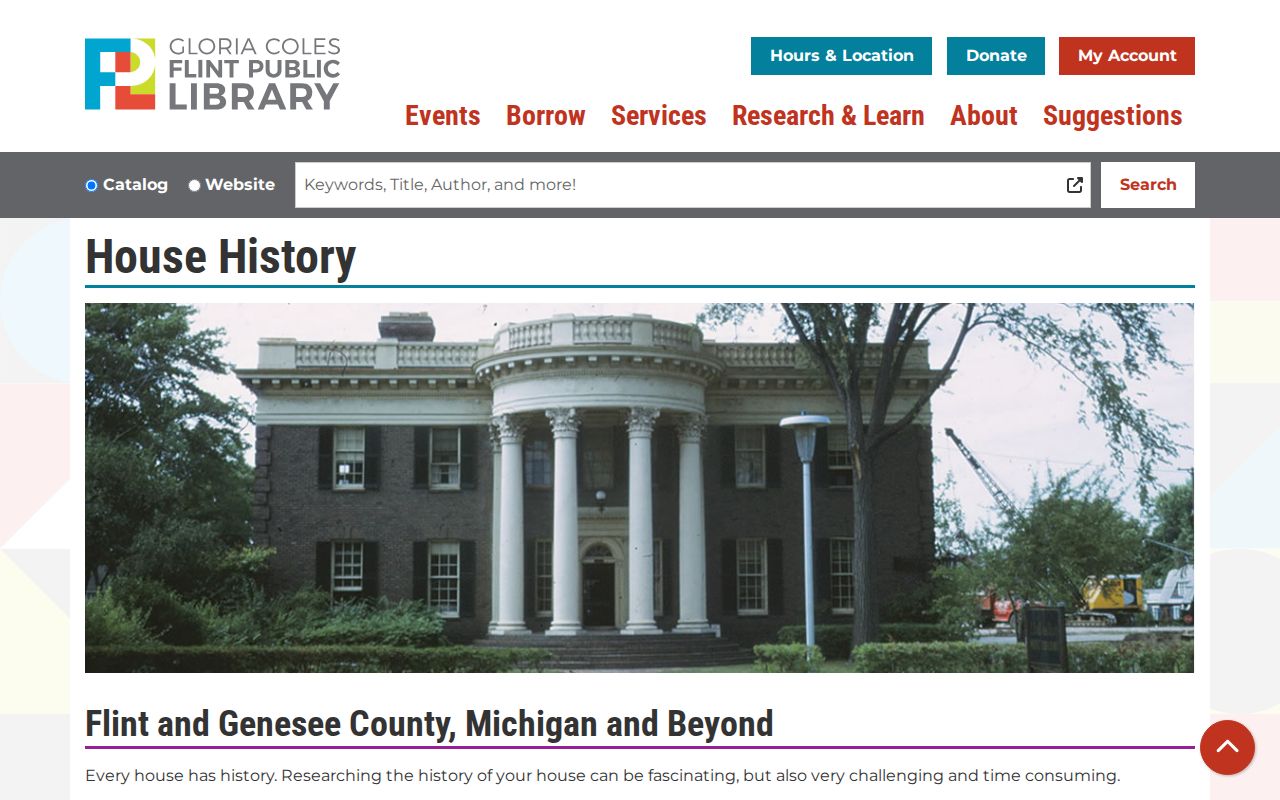
Develop dated leads through the library trail. Then return to a deed, directory, census, permit, or probate record to confirm each one.
Grand Blanc Township Past Residents in Directories
Ownership records answer only part of a past-residents question. Flint Public Library holds local-history and genealogy material for Flint and nearby communities from the 1890s to the present. It does not publish exact Grand Blanc directory runs. Search a surname in the alphabetical section first. Then check the same year's street section. The volumes themselves sit along the Grand Blanc Township city directories collection route.
Directory entries are dated snapshots. One line can yield an address, a household notation, an occupation, a phone reference, or a printed owner marker. Entries also mislead. A volume can omit a person, use initials, list a business address, or file a street under the Flint label. A directory listing proves presence for that edition only, not uninterrupted residence.
- Copy the full entry and edition year, including initials and the street or house number.
- Check the street section for the same year, then repeat in nearby editions for a change in names or numbers.
- Pair a 1929-1932 Flint directory with the 1930 federal census where the address and enumeration geography fit.
- Compare the directory date with the deed sequence and retain conflicting labels rather than forcing a match.
The National Archives lists selected Flint directories for 1929-1932. Census schedules show which people were recorded together. But a census district never matches modern township boundaries. FPL obituary indexes and probate leads can mark an endpoint, such as relatives, an estate role, or a later address. Verify each endpoint in the proper record.
Grand Blanc Township Census Records Checkpoint
The 1930 pairing works well. NARA identifies Flint directories for 1929-1932, and federal individual schedules open after a 72-year privacy period. Start with the address from the directory. Then use enumeration-district descriptions, maps, nearby streets, and family details to test whether a census entry fits. Modern Grand Blanc Township boundaries and postal labels can mislead an otherwise plausible search.
For older records, search county, township, church, cemetery, and directory labels instead of assuming a current mailing city. Grand Blanc was incorporated in 1833. Its record trail spreads across township, county, state, federal, and library custodians. That spread slows every search. Two gaps stay visible. No distinct Grand Blanc directory series and no local Sanborn map run appear among the published holdings.
Note: Township aerials from 1999, 2001, 2004, 2006, 2009, and 2018 can show later physical change, but they do not prove an earlier occupant or replace a dated record.
Grand Blanc Township Address Record Gaps
No township-wide street renumbering or renaming is on record. Never assume a number changed just because a directory and tax record disagree. Differences often have other causes. Compare old and current street spelling, the PID, the subdivision lot, the legal description, and the parcels on either side. Historic maps and road-corridor context help too. The 1990 Hill Road Corridor Plan, the 1996 Holly, Baldwin, and Saginaw corridor plan, and the 2008 Saginaw Street study give useful road context, not proof of a house-number change.
Permit and occupancy files can reveal construction, alteration, applicant, owner, or inspection timing when no online record exists. Ask the Township Building Department. Or file a focused FOIA request with the township. Obituaries, probate files, cemetery readings, and local-history sources can close a family-history thread. Each source adds one thread. None should be used to track or contact a living person.